
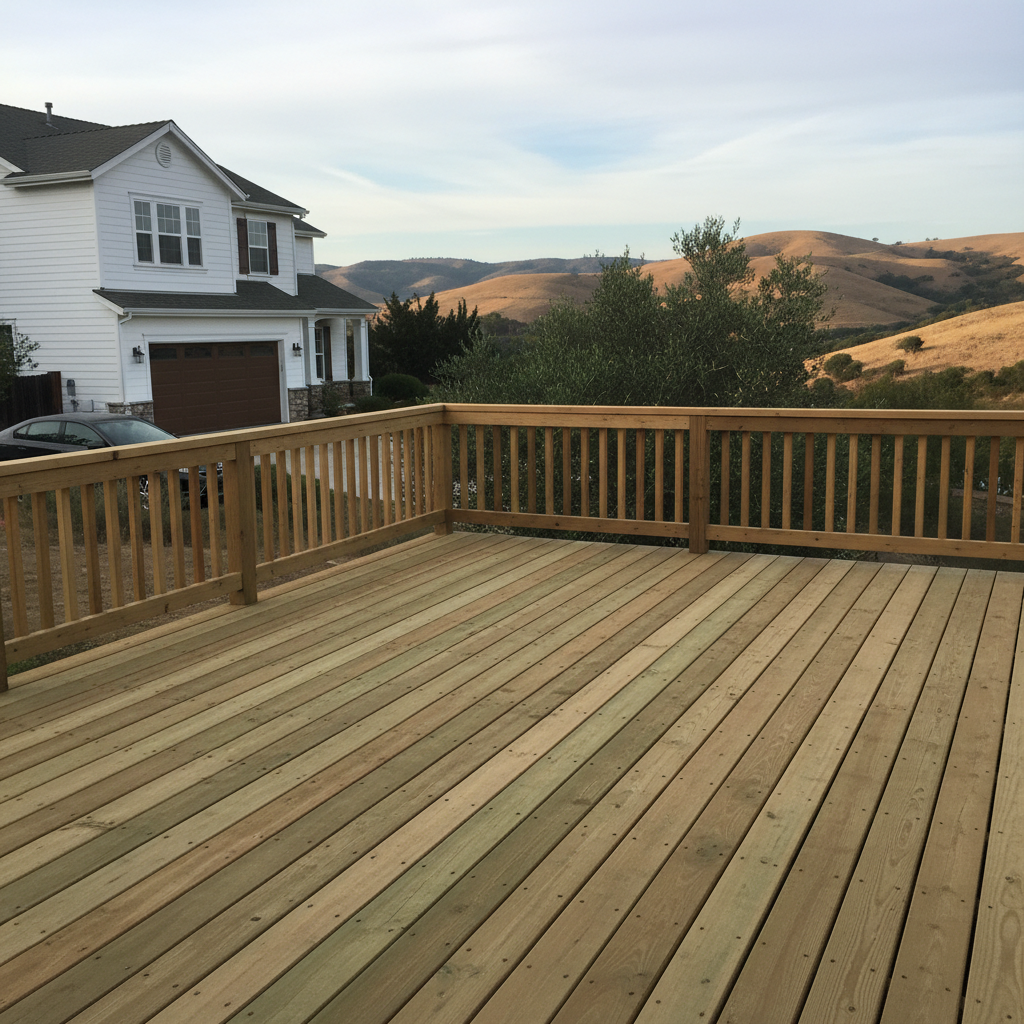
Moreno Valley has no shortage of guys with a truck and a stack of business cards who'll build you a deck over a weekend. Some of them do fine work. A lot of them don't, and the problem is you usually can't tell the difference until two summers later when the ledger board is pulling away from the house or the footings have heaved. Here's what actually separates a deck builder worth hiring from one you'll be calling back to fix things.
Start with the permit, not the price
Any deck attached to the house, or any deck more than about 30 inches above grade, needs a permit through the City of Moreno Valley Building and Safety Division. That's not a formality. It means an inspector checks the footings before you pour concrete, checks the ledger attachment and flashing before the decking goes down, and signs off on the railing height and baluster spacing at the end. A contractor who tells you permits are a waste of time and money, or who says he'll "keep it under the radar," is telling you he doesn't want an inspector looking at his work. That should tell you something.
If your lot backs onto a common area or sits inside one of the newer HOA communities, like Rancho Belago or parts of Spring Valley, add the HOA architectural review to the list. They'll usually want a site plan showing setbacks from the property line before they approve anything. A builder who's worked in the area already knows this and asks for your HOA packet up front instead of finding out three weeks into the job.
What the ground here actually does
Soil across Moreno Valley isn't uniform. Some lots sit on decomposed granite and sandy loam that drains fast and compacts well. Others, especially in the older flatter sections, have more clay content that swells when it gets wet in the winter rains and shrinks hard in a dry August. That movement is exactly what cracks undersized footings and tilts deck posts over a few years. A footing that's poured too shallow, or sized for a smaller deck than what's actually going on top of it, is the single most common structural failure we see on repair calls. Code minimums exist for a reason, and a contractor should be able to tell you the footing diameter and depth he's using and why, not just "don't worry, it's plenty."
Summer heat matters too. Concrete poured on a 105 degree July day cures faster on the surface than it does deeper down, which can leave it weaker than it looks. Anyone pouring footings in peak summer should be managing that with curing compound or by timing the pour for early morning, not just walking away and coming back the next day.
Materials, and the questions a good builder asks you first
A contractor who jumps straight to quoting composite decking or pressure-treated lumber without asking how much sun the deck gets, whether you want to stain it every couple years or never touch it again, and what you're actually using the space for, is quoting a price, not designing a deck. Wood needs re-sealing roughly every 2 to 3 years out here, sooner on a south-facing deck that takes full sun most of the day, because UV and heat dry out the finish faster than they would somewhere cooler and more humid. Composite doesn't need staining but it does expand and contract with temperature swings, so the gapping between boards and the fastening pattern at the ends matters more in our heat than it would in a mild climate. If a composite installer isn't leaving expansion gaps sized for the product and the board length, you'll see buckling within a year or two.
Ledger attachment is the other thing worth asking about directly. The ledger board is what ties the deck to your house, and it has to be lag-bolted or through-bolted into the rim joist, properly flashed so water doesn't get behind it and rot the sheathing. This is the single point of failure on a huge share of older decks we get called to repair, because it was nailed instead of bolted, or flashed badly, or not flashed at all. Ask the contractor how he attaches the ledger. If the answer is vague, that's your answer.
Red flags worth walking away from
- No license number, or a license number that doesn't match the name on the contract.
- Wants full payment up front, before any material is delivered.
- Won't pull a permit, or tells you it's not needed for your project.
- Quote is a single number with no breakdown of footing size, lumber grade, or railing spec.
- Can't tell you how many posts and footings your specific deck needs, or gives a vague answer like "enough."
- Pressures you to sign same-day with a "today only" discount.
None of these alone is necessarily a dealbreaker. All of them together, run.
What a solid quote actually looks like
A real bid breaks the job into parts: demolition if there's an old structure coming out, footings and framing, decking material and fasteners, railing, and any permit and inspection fees. It should name the lumber grade or the specific composite product, not just "wood" or "composite." It should note joist spacing, which for most residential decking runs 16 inches on center, tighter if you're going with a thinner composite board that needs more support. And it should tell you roughly how long the job takes, because a straightforward 300 square foot deck on an existing slab is a different timeline than a raised deck with a dozen new footings and a full tear-off of what's there now.
Ask for references from jobs at least two or three years old, not ones finished last month. A deck looks great the day it's built. What matters is whether the railing's still tight, the boards haven't cupped, and the footings haven't shifted after a winter of rain and a summer of heat.
We do framing and structural repair, resurfacing, railing work, and new builds across Moreno Valley and the surrounding towns, so we see the decks that were done right alongside the ones that weren't. If you want a second opinion on a quote, or want to walk through what your lot and your plans actually need before you sign anything, take a look at our deck builder work and get in touch.